
Written by Melvin Bosso… A fictional conversation
Setting the Scene
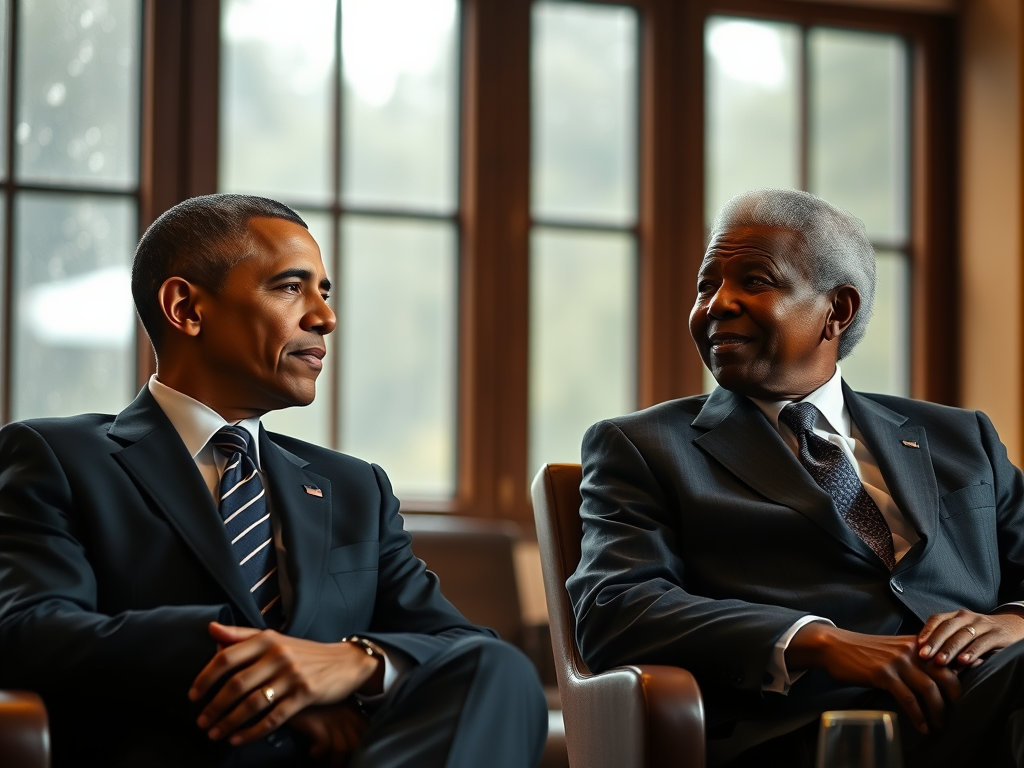
The room was quiet but warm, tall windows breathing in the scent of rain-soaked earth, soft jazz whispering in the background. Nelson Mandela sat upright, hands joined lightly, his eyes alive with that gentle gravity only time can teach. Beside him, Barack Obama leaned a little forward, smiling with that familiar mix of irony and empathy, the kind of smile that means I understand exactly what you’re talking about.
I, Melvin Bosso, had barely slept the night before. Who could? I was about to sit across from two of history’s greatest moral architects, one who turned a prison cell into a school for humanity, and another who taught an age of cynicism to hope again. Today, I wanted to ask both about something bigger than politics: the condition of modern leadership itself.
Introduction: Barack Obama
Barack Obama’s leadership emerged from the crucible of modern complexity, a world already shaped by technology, cynicism, and rapid change. He combined intellectual rigor with an uncommon calm, turning disagreement into dialogue and idealism into pragmatic action. As the first African American president of the United States, he led not by thunder but by tone, by reminding people that “we are the ones we’ve been waiting for.” His leadership was both deeply personal and unmistakably collective, defined by the belief that progress, though slow, is real when people refuse despair.
Introduction: Nelson Mandela
Nelson Rolihlahla Mandela embodied leadership through endurance. His life stretched from tribal councils to global diplomacy, his influence carrying the timeless cadence of humility and forgiveness. Prison could not harden him; instead, it refined his conviction that freedom without peace is hollow. Mandela’s greatness was never in dominance, but in restraint, the ability to act without anger, to lead without vanity. Above all, he proved that leadership does not reside in power, but in the moral courage to love those who once sought your undoing.
Opening the Conversation
I cleared my throat and began softly, quoting Félix Houphouët-Boigny, the first president of Côte d’Ivoire:
“Peace is not a vain word. It’s a behavior.”
Both men looked up and smiled.
“Perhaps that’s the perfect place to begin,” I said. “Peace, whether in politics or in business, still feels like the most misunderstood form of strength. Leadership today often mistakes boldness for noise, and decisiveness for wisdom. So I’d like to know: is there such a thing as modern leadership? Or are we simply decorating old truths with new words?”
1. Is there such a thing as modern leadership?
Obama:
“Well, Melvin, every generation believes it has reinvented leadership, probably because each one is living through its own storm. But if you peel back the noise, the fundamentals don’t change. It’s still about judgment, empathy, and the ability to move people toward something that matters.
“What has changed is the pressure. Today’s leaders aren’t starved for data; they’re drowning in it. They confuse motion with meaning. Everyone feels they must look in control, post confidence, and be decisive on cue, which makes decisions shallow and relationships transactional.”
Mandela:
“When you talk about pressure,” Mandela said softly, “I remember being in prison. The world outside changed faster than we could imagine, yet inside we learned a slow truth: leadership does not rush. It listens. I had no dashboards, no metrics, only people. Men who were angry, frightened, hopeful. Leadership, in those conditions, was about composure.
“So to answer you: no, my friend. Leadership is never modern. Only the context changes. Leadership is an old tree; each generation only tends its branches.”
Melvin:
“I’ve seen that too,” I replied. “Today’s business world worships activity. But as Houphouët-Boigny once said, ‘Patience can achieve anything when strength is useless.’ Maybe what we lack is not intelligence but restraint.”
Obama chuckled. “Exactly. Everyone can chase waves. The wise learn to feel the current.”
2. Should people, and companies, transform?
Melvin:
“My second question comes straight from the trenches of corporate life. Every company wants ‘transformation’, cost, digital, cultural, operational. Yet a year later, most are exhausted, not transformed. Why is that?”
Obama:
“We’ve turned transformation into theater. Leaders announce it, consultants brand it, employees endure it. But transformation isn’t a rebrand, it’s a reckoning. It begins when you stop pretending the old model still works.
“Real change is granular, repetitive, slow. It feels underwhelming until suddenly it compounds.”
Mandela:
“You remind me of those who thought the revolution would come overnight,” Mandela said. “When freedom came, people expected miracles. But transformation was not in the speeches, it was in the schools we built, the habits we changed, the forgiveness we practiced.
“Orwell was right: progress is real, but slow and disappointing. A wise leader must make peace with that. Transformation without humility becomes imitation.”
Melvin:
“I like that, imitation. Companies celebrate speed like virtue, forgetting that speed without truth is chaos.”
Mandela smiled. “The impatient reformer often burns the bridge before crossing it.”
3. Are weaknesses an impairment to growth?
Melvin:
“Let’s talk about weakness, or what people call weakness. Today’s culture prizes perfection: flawless CEOs, optimized lives, motivational slogans. Yet every authentic leader I’ve studied seems shaped by constraint and failure. Are weaknesses a liability, or can they become strength?”
Mandela:
“When they put us on Robben Island,” he said, “they thought they were burying us. But suffering taught us to see each other’s hearts. My anger, which was once my poison, became my fire, disciplined, directed, controlled. Weakness is not the enemy. Denial is.”
He looked directly at me. “When you know your wound, you also know your threshold.”
Obama:
“I’ve met leaders who built entire careers hiding their flaws. It’s exhausting, and dangerous. Because once people see your imperfection, which they will, the illusion collapses. Vulnerability isn’t weakness. It’s the starting point of trust.
“The anxious leader often becomes the best listener. The doubtful one learns to prepare better. Weakness isn’t meant to be erased; it’s meant to be integrated.”
Melvin:
“I love that. Maybe imperfection is nature’s way of preventing arrogance. In consulting, the leaders I admire most are those who admit they don’t have all the answers but never stop seeking them.”
Mandela nodded. “And that humility is contagious. When a leader breathes honesty, the team exhales fear.”
4. Do values still matter?
Melvin:
“In today’s economy, values are everywhere in slogans but scarce in action. Executives use words like ‘integrity’ or ‘purpose,’ yet compromise them for short-term gain. Do values still matter in a world driven by algorithms and ambition?”
Mandela:
“Values are not decoration; they are defense. Without them, success is fragile.
“When I was released from prison, people asked how I could forgive the very system that condemned me. But forgiveness was not moral luxury, it was strategy. A peace built on revenge dies young. But a peace built on values endures.”
He paused. “That’s why, Melvin, your Houphouët-Boigny said it best: ‘Peace is not a vain word. It’s a behavior.’”
Obama:
“When you’re leading a country, or even a company, your values get tested every day. Every shortcut promises speed. Every compromise feels rational. But integrity is like health; you only notice its absence when it’s too late.
“What’s tricky today is visibility. Everything you do is public. So leaders need not only values, but consistency. Transparency without integrity just exposes the rot faster.”
Melvin:
“So, in a noisy world, values may not make you louder, but they make you last.”
Obama smiled. “Exactly. In an age of distrust, trust is currency.”
5. If I were 23 today, what should I know about leadership?
Melvin:
“For a fifth question, imagine I’m 23 again, or better, imagine we’re advising someone who is. Forget race, gender, or geography. What should a young person know about leadership today?”
Obama:
“I’d say: lead yourself before you lead others. Manage your ego, your time, and your reaction to failure. Leadership begins in private long before it’s seen in public.
“Also, seek reality. Don’t hide in analysis. Sit with frontline workers; listen to customers. Understanding grows only where life is messy.
“And finally, stay curious and kind. The world rewards cleverness, but it remembers kindness.”
Mandela:
“I would tell that young woman or man what I told myself many years ago, do not mistake cynicism for wisdom. The world will tempt you to grow hard, but resistance is only strength when softened by compassion.
“Also, learn to listen. Listening is an act of peace. It invites understanding before judgment.”
He smiled gently. “And smile, even when you disagree. A frown can build no bridge.”
Melvin:
“It’s interesting that both of you return to humility and empathy. Maybe that’s the forgotten art of modern leadership, not commanding, but connecting.”
Obama nodded. “Exactly. The title doesn’t make the leader; listening does.”
6. How does technology change leadership?
Melvin:
“Here’s my last question, one neither of your generations faced at this scale: technology. Today, leaders reach millions they’ll never meet. A single clip or tweet can define them for years. When people can see you more than they can knowyou, how should a leader handle that distortion?”
Obama:
He sighed lightly. “That’s the paradox of our time. Technology amplifies visibility but dilutes proximity. You’re seen by everyone and known by no one.
“The danger is performing leadership instead of practicing it, mistaking influence for impact. The best antidote is groundedness. Spend less time watching your reflection and more time touching reality. The algorithm may reward outrage, but real trust grows offline.”
Mandela:
“My friend,” Mandela said, “power always changes shape, but not substance. Technology is just faster speech. But remember: words travel quicker than hearts. The wise leader never confuses reach with relationship.”
He paused, then looked at me with warmth. “The young must use technology to serve truth, not vanity. When the light shines brighter, it must also reveal deeper honesty.”
Melvin:
“I hear that. In Houphouët-Boigny’s words, ‘The tree that hides the forest is pride.’ Technology tempts us to build trees of pride, personal brands, constant posting, instant validation, while losing sight of the forest of purpose. Maybe leadership today is about bringing people back to that forest.”
Obama smiled. “That might be your next article.”

Closing Reflections
As the evening dimmed, the three of us sat in thoughtful silence. Outside, a faint drizzle blurred the horizon, the kind that makes the world look softer, more forgiving.
Mandela spoke first. “You asked whether leadership is modern. The answer is simple: leadership is memory in motion. It learns, but never forgets.”
Obama leaned back and added quietly, “Leadership demands that you stay awake, to yourself, to others, to the current beneath the waves.”
I looked down at my notes, a constellation of phrases:
- Leadership is human, not modern.
- Transformation is patient truth, not performance.
- Weakness is design, not defect.
- Values are anchors, not ornaments.
- Connection outlasts visibility.
- And peace, as Houphouët-Boigny said, is not a word, but a behavior.
We all rose. Mandela clasped my hand, Obama rested a hand on my shoulder. “Remember,” Obama said, “our generation built the bridge. Yours must keep it steady.”
Mandela smiled. “And keep it kind.”
When they left, the silence they carried lingered, not empty, but full, like a river still moving long after the rain has stopped.


Leave a Reply