
Written by Melvin Bosso, You will recognize the characters of the tv show Seinfeld
George read the email from Tamia Professional Services for the fifth time in the hotel lobby.
“Senior transformation consultants to design a cost‑transformation framework for our marketing agency during the Paris–Lyon drive,” he muttered.
He suddenly glared at Jerry.
“You’re giving me the ‘it’s not you, it’s me’ routine? I invented ‘it’s not you, it’s me’! Now apparently I invented consulting, too?”
“Efficiency,” Elaine said, tightening her blazer. “In France, they do strategy on trains. We’re already underperforming by taking a car.”
Kramer burst through the revolving door, keys jingling.
“Allons‑y, mes consultants! Company car’s outside. Manual transmission. Very European. Very…transformational.”
Jerry adjusted his sunglasses.
“I just want to confirm: we’re four comedians about to redesign a company on the A6. This is the pilot episode of our careers.”
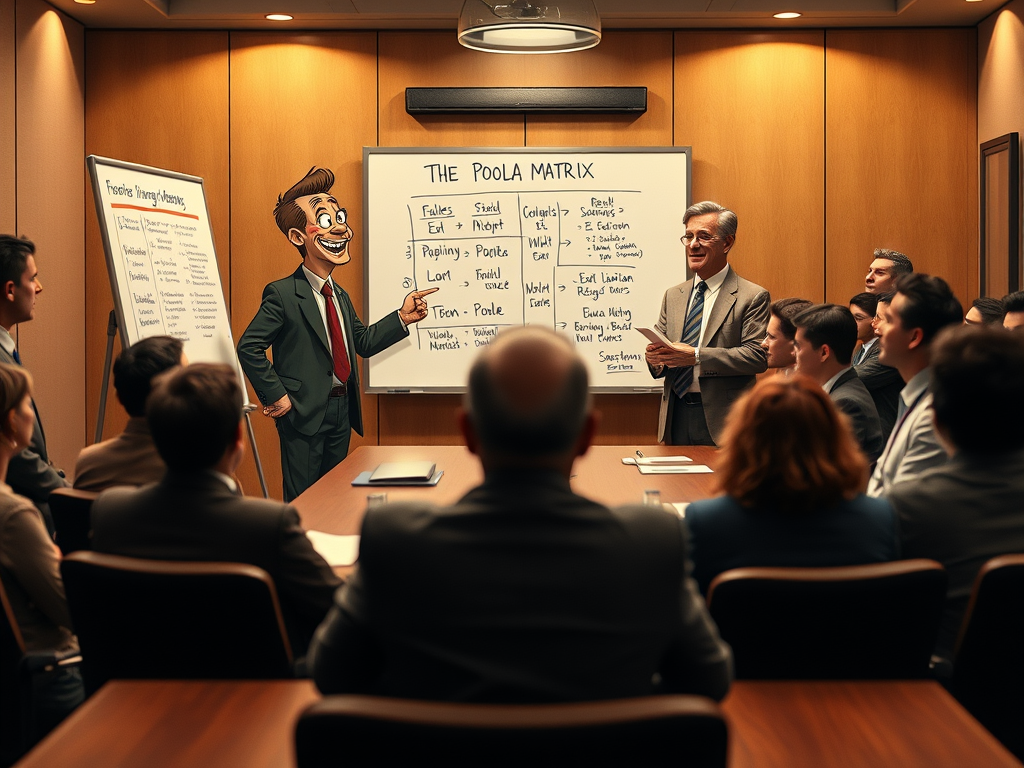
The road to the Paola Matrix
The Renault lurched away from the curb with Kramer at the wheel, chewing up Parisian side streets on its way to the highway.
Jerry opened the printed brief like a script.
“Tamia Professional Services,” he read. “Marketing agency. They ‘help clients break growth barriers’ and ‘accelerate brand performance.’”
“So they’re already breaking barriers,” George said from the back seat. “Now we have to break the barriers on the barriers. It’s barrier‑inception.”
Kramer shook his head.
“You know what your problem is, George? Same as always. You contribute nothing to society!”
George sputtered. “Nothing? I just got promoted from ‘man who contributes nothing’ to ‘senior transformation consultant who contributes nothing.’ That’s growth!”
Elaine snatched the brief.
“They complain about clients dragging their feet, internal teams resisting change, and nobody having time for real analysis. Classic.”
“So they’re tired, scared, and busy,” Jerry said. “Our people.”
“Let’s not overthink this,” George said. “We pitch them something impressive: a ‘holistic cost‑transformation metrix.’”
“Matrix,” Elaine corrected.
“I like metrix,” Jerry replied. “Sounds like a pharmaceutical. ‘Ask your doctor if Metrix is right for you.’ Side effects may include slide decks and sudden layoffs.”
Kramer drummed the steering wheel.
“Forget the branding. First question: when do their clients actually bring in outsiders? That’s our compass.”
“You mean,” Jerry said, “why a company breaks its barriers and invites strangers into the budget?”
“Exactly!” Kramer shouted, swerving slightly. “When do they say, ‘Okay, bring in the weirdos’?”
Building the axes
Fog thinned as they left Paris, fields sliding past in muted winter colors.
Elaine took Jerry’s notebook and sliced it with a vertical line.
“First, we need a scale. Consultants love scales.”
“Complexity,” Kramer said. “Regional, national, global.”
Elaine wrote on the left:
- Low complexity: Regional
- Medium complexity: National
- High complexity: Global
“There,” she said. “Vertical axis: complexity. The higher you go, the more they need outside help.”
“So up is pain,” Jerry said. “Down is mild discomfort. It’s like a medical chart for budgets.”
“Now the columns,” Kramer continued. “Why they call in outsiders.”
“Speed,” Elaine said. “Speed and resources. They don’t have time.”
First column: Speed/resources.
“Expertise,” George added. “Capability. They want people who look like they know what they’re doing. That’s us. From a distance.”
Second column: Expertise/capability.
“Change management,” Kramer said. “Upskilling. People panic when you tell them their job is going to change.”
Third column: Change management/upskilling.
“And they want benchmarks,” George went on. “Objectivity. Best practices. Something to blame when it all goes wrong.”
Fourth column: Benchmarking/objectivity/best practices.
“Finally, risk,” Kramer said. “Risk mitigation, acceleration. They’re afraid to move without a professional fall guy.”
Fifth column: Risk mitigation/acceleration strategy.
Elaine looked down at the emerging grid and smiled.
“Five reasons a company breaks its internal walls and lets someone like Tamia in.”

Coloring the fear
They filled the cells as the car hummed down the A6.
Green meant a strong reason to call for help, yellow meant “we’re worried,” red meant full‑blown panic.
“For regional, low‑complexity work,” Elaine said, “they mostly need speed and a bit of expertise. One or two green lights, tops.”
“National is where it starts to hurt,” Kramer added. “More politics, more layers. You need change management and benchmarks.”
“Global?” Jerry asked.
“Global is a five‑alarm fire,” George said. “Everything’s red. Speed, expertise, change, benchmarks, risk. It’s the ‘No soup for you!’ of cost transformation, except the soup is stability.”
Elaine shaded the bottom row heavily.
“This is where Tamia can become indispensable. Global, messy, high‑stakes work.”
Jerry studied the page.
“It’s like we’ve turned anxiety into a board game. Land on the wrong square, you pay for consultants.”
Naming the invention
They stopped at an aire de service for coffee that tasted like burnt ambition.
At a plastic table, Elaine spread the notebook; Kramer paced with a tiny espresso like it was rocket fuel.
“We still need a name,” she said. “Something with history. Gravitas.”
Jerry squinted.
“It looks like something a very stern person invented at a workshop with no snacks. Some legendary Paola in a dark suit.”
George snapped his fingers.
“What about the Tamia Matrix?”
“Too obvious,” Kramer said. “You don’t name a great framework after the client. You name it after the genius.”
“Which they think is Paola,” Jerry said.
Elaine nodded slowly.
“We say this is the Paola Matrix, an evolution of Paola’s original thinking, adapted for marketing services.”
She wrote at the top in heavy letters: PAOLA MATRIX.
Underneath: Top five reasons a company breaks internal barriers to welcome outside help for cost‑transformation projects, across different levels of complexity.
Jerry read it and shivered.
“That sounds dangerously legitimate.”
Kramer grinned.
“Dangerously legitimate is where the money is.”
The dress rehearsal
Back on the road, Elaine turned the matrix into a narrative.
“Tamia wants to know when their clients are ready to bring in outside help. We show them that readiness depends on complexity and on these five drivers.”
“Regional,” Kramer said, “you sell speed. National, you add expertise and change support. Global, you bring the full transformation circus.”
“Then we show them,” George said, “that most of their growth sits in the middle and top rows, national and global, where the grid gets yellow and red. That’s where they aim their best people.”
“And if they don’t,” Elaine added, “no soup for you!”
Jerry laughed.
“That’s the closing line. We tell them: ignore the Paola Matrix, and you’re the soup Nazi of opportunity, you keep saying no to your own growth.”
Kramer slapped the steering wheel.
“Beautiful! We take their fear, we organize it, we color‑code it, we sell it back to them.”
Meeting the leadership of Tamia
By the time they reached Lyon, the matrix had been rehearsed into a full pitch.
They stepped into Tamia’s glass‑walled office, where three figures were waiting at the end of a long table.
Newman turned first, smirking, a Tamia badge pinned to his blazer.
“Well, well, well,” he said. “Hello, Jerry.”
Next to him sat Uncle Leo, wearing a loud tie and an expression of permanent suspicion.
“Jerry,” he called out across the room, “you never call, you never write, and now you show up with a matrix?”
At the far end was Elaine’s boss, impeccably dressed, already tapping a pen against a leather notebook.
“Elaine,” he said, “I assume this little road experiment produced something more substantial than gas receipts.”
They took their seats awkwardly.
Newman flipped through the printed deck and stopped at the centerpiece slide.
“The Paola Matrix,” he read. “Complexity scale, five reasons to bring in outside help. Hmmm.”
Uncle Leo squinted. “You came up with this in a car? You see this?” he said, nudging Newman. “My nephew, the highway strategist.”
Elaine’s boss leaned forward.
“The structure is…surprisingly sharp,” he said. “We like the linkage of complexity and triggers. But who’s presenting?”
Jerry opened his mouth, but Newman cut him off, eyes gleaming.
“I think we all know who should present,” Newman said. “The man who contributes nothing to society…and the man who almost drove us into a toll booth.”
He pointed. “George and Kramer.”
George choked. “Me?”
Kramer beamed. “Showtime.”
Elaine’s boss nodded.
“Fine. George, you’ll anchor the narrative. Kramer, you’ll handle the energy and client examples. Jerry and Elaine, you’ll support and handle Q&A.”
Uncle Leo leaned back, satisfied.
“Look at this, Jerry. From nothing to a matrix in one car ride. You’re like Einstein, but with worse posture.”
Newman closed the folder.
“We present to the full Tamia leadership tomorrow,” he said. “If this Paola Matrix convinces them, you’re not just consultants for the day, you’re the new reference model.”
George swallowed, clutching the deck like a life raft.
Kramer rolled his shoulders, already walking through an imaginary stage entrance.
Jerry glanced at Elaine.
“Four comedians, one matrix, three executives,” he whispered. “What could go wrong?”
Elaine smiled thinly.
“If they buy it, Jerry, there will be soup for us.”

Leave a Reply